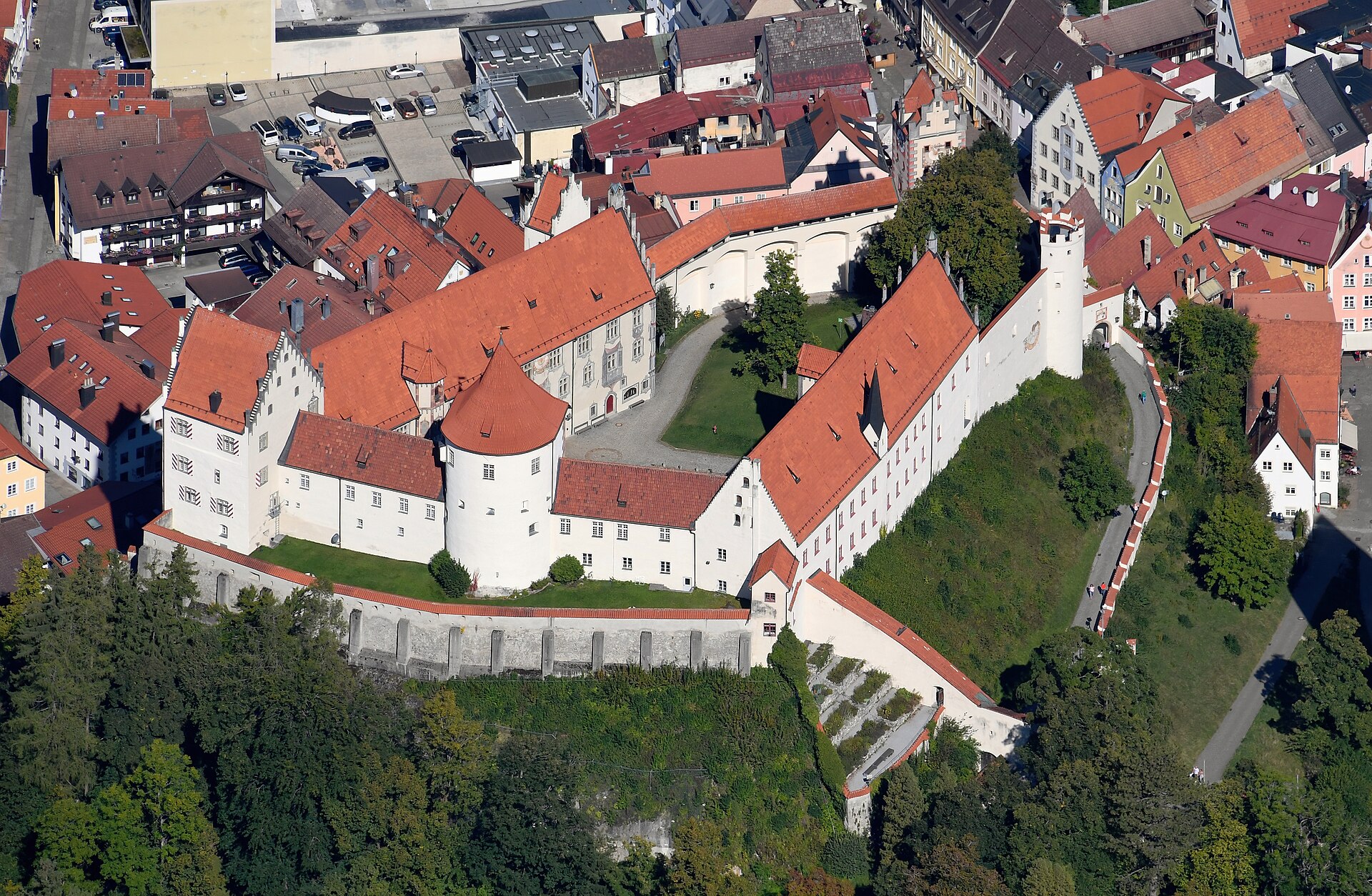
Location: Germany Bavaria Füssen
Late Gothic castle above Füssen's old town, once a seat of the bishops of Augsburg – known for the painted trompe-l'œil architecture in its courtyard.
Interesting facts
- The painted windows and oriels in the courtyard are illusionistic paintings from around 1499.
- Since 1931 the north wing has housed a branch gallery of the Bavarian State Painting Collections.
- Crown Prince Maximilian considered the castle as a summer residence but bought Hohenschwangau instead in 1832.
Why visit
- Late Gothic illusionistic painting in the courtyard
- Gallery of late Gothic Swabian art
- Setting above Füssen's old town
The High Castle (Hohes Schloss) rises on a hill above the old town of Füssen. A fort already stood here in late Roman times. In the Middle Ages the hill was disputed between St. Mang’s Abbey, the bishops of Augsburg and the Bavarian Duke Louis II the Strict; a settlement in 1292 ended the dispute, and from 1322 the castle was the seat of the local administration of the bishops of Augsburg.
The castle took on its present form from 1486 under Prince-Bishop Friedrich II von Zollern. It is famous for the late Gothic illusionistic paintings created around 1499 on the courtyard façades and the gate tower, which merely simulate windows, oriels and cornices.
Since 1931 the north wing has housed a branch gallery of the Bavarian State Painting Collections showing late Gothic Swabian painting. The Knights’ Hall retains a carved and painted late Gothic wooden ceiling.
History
Late Roman fort; in the Middle Ages disputed between St. Mang's Abbey, the bishops of Augsburg and Duke Louis II the Strict (settlement of 1292). From 1322 seat of the Füssen administration, rebuilt and extended from 1486 under Prince-Bishop Friedrich II von Zollern. From 1798 to 1800 the castle served as an Austrian military hospital.
Special features
Late Gothic complex with a courtyard whose façades were decorated with painted trompe-l'œil architecture around 1499. Knights' Hall with a carved, painted wooden ceiling attributed to Jörg Lederer. The gate tower holds the clock from Füssen's demolished Augsburg Gate tower.
Map
Opens an external route planner. Please check access and opening times before you set off.
Nearby
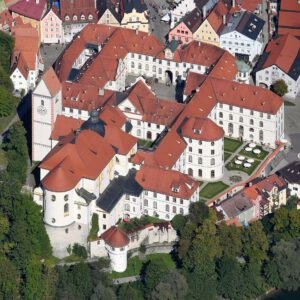
St. Mang’s Abbey
Füssen, Bavaria
0.1 km away
Former Benedictine abbey in Füssen's old town, rebuilt in Baroque style by Johann Jakob Herkomer – today home to the town hall, the town museum and the library.
Route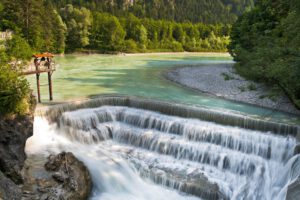
Lech Falls
Füssen, Bavaria
0.6 km away
Waterfall on the River Lech at the edge of Füssen – just under eight metres high, with a gorge, the King Max footbridge and the legendary Magnustritt.
Route
Faulenbach Valley
Füssen, Bavaria
1.5 km away
Protected karst valley near Füssen with the Mittersee and Obersee lakes, outdoor pools, a Kneipp facility and hiking trails – along the Faulenbach stream between the Alatsee and th…
Route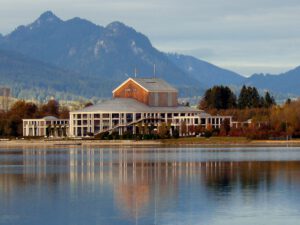
Festspielhaus Neuschwanstein
Füssen, Bavaria
2.3 km away
Musical theatre on the shore of the Forggensee in Füssen, opened in 2000 – its terrace looks across the lake to Neuschwanstein Castle, about four kilometres away.
Route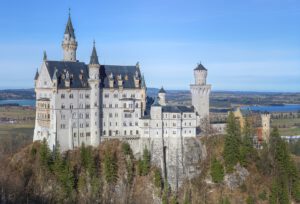
Neuschwanstein Castle
Schwangau, Bavaria
4.0 km away
King Ludwig II's unfinished castle on a rocky ridge above Hohenschwangau in the Bavarian Allgäu – built in Romanesque Revival style from 1869 and part of a UNESCO World Heritage Si…
Route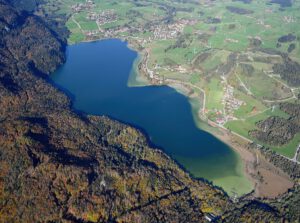
Sources
Image: Carsten Steger · CC BY-SA 4.0 · Wikimedia Commons
