Location: Belgium Wallonia Dinant
Prehistoric cave above the River Lesse at Pont-à-Lesse (Dinant) – site of a 3.8-centimetre ivory figurine and of Neanderthal remains.
Interesting facts
- The ivory figurine from Trou Magrite is about 3.8 centimetres high.
- More than 50,000 animal bones come from the cave, mainly horse, reindeer and woolly rhinoceros.
- From 2015 remains of an adolescent and a baby Neanderthal were identified in the old collections.
Why visit
- An important Palaeolithic site
- Setting above the Lesse valley
Trou Magrite is a prehistoric site at Pont-à-Lesse in the Dinant area. The cave lies on a terrace about 26 metres above the Lesse, close to where it flows into the Meuse, and consists of a large chamber around 6 metres wide and 12 metres high with a small vestibule.
The geologist Édouard Dupont examined the cave in 1864 and in 1867 excavated it almost completely down to the bedrock. His stratigraphy later helped to define the cultural sequence of the late Ice Age in Western Europe. The cave was occupied in phases from the Mousterian (Middle Palaeolithic) through the Aurignacian and Gravettian to the Iron Age.
The best-known find is an ivory figurine about 3.8 centimetres high, often called the “Venus of Trou Magrite”. Other finds include an engraved reindeer antler, more than 50,000 animal bones and – identified when the old collections were re-examined from 2015 – the remains of two Neanderthals.
History
First examined by Édouard Dupont in 1864, almost completely excavated in 1867, several poorly documented investigations in the 20th century, control excavation at the terrace edge in 1991–1992, re-analysis of the collections from 2015 identifying two Neanderthals.
Special features
Cave on a terrace around 26 metres above the Lesse with a large chamber of about 6 × 12 metres. Finds from the Mousterian, Aurignacian and Gravettian up to the Iron Age.
Map
Opens an external route planner. Please check access and opening times before you set off.
Nearby
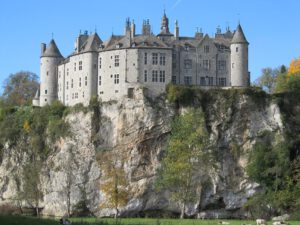
Walzin Castle
Dinant, Wallonia
0.7 km away
Castle on a rock more than 50 metres high above a bend of the River Lesse near Dinant – privately owned and only visible from outside.
RouteLa Naulette Cave
Dinant, Wallonia
1.5 km away
Cave on the left bank of the Lesse near Dinant – in 1866 a Neanderthal jaw was found here, early evidence for Darwin's theory.
Route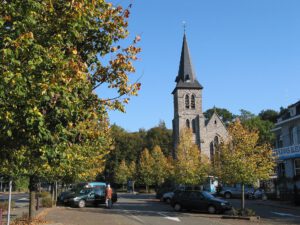
Church of Saint Anne, Anseremme
Dinant, Wallonia
1.8 km away
Neo-Gothic church of 1906–1907 at the confluence of the Lesse and the Meuse in Anseremme – with a 12th-century baptismal font.
Route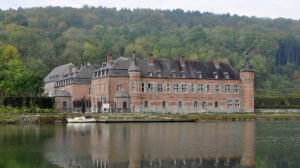
Castle of Freÿr
Hastière, Wallonia
1.8 km away
Renaissance castle on the bank of the Meuse at Hastière, with gardens said to follow the model of Versailles, old orange trees and what is considered Belgium's oldest orangery.
Route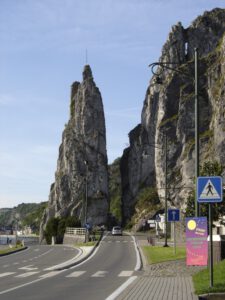
Rocher Bayard, Dinant
Dinant, Wallonia
2.5 km away
A rock needle about 40 metres high on the Meuse between Dinant and Anseremme – split, according to legend, by the hoof of the magic horse Bayard.
RouteTrou des Nutons, Furfooz
Dinant, Wallonia
3.3 km away
Prehistoric cave above the Lesse at Furfooz (Dinant) – site of hearths, flint tools and engraved reindeer antler rods.
Route