Location: Austria Carinthia Klagenfurt am Wörthersee
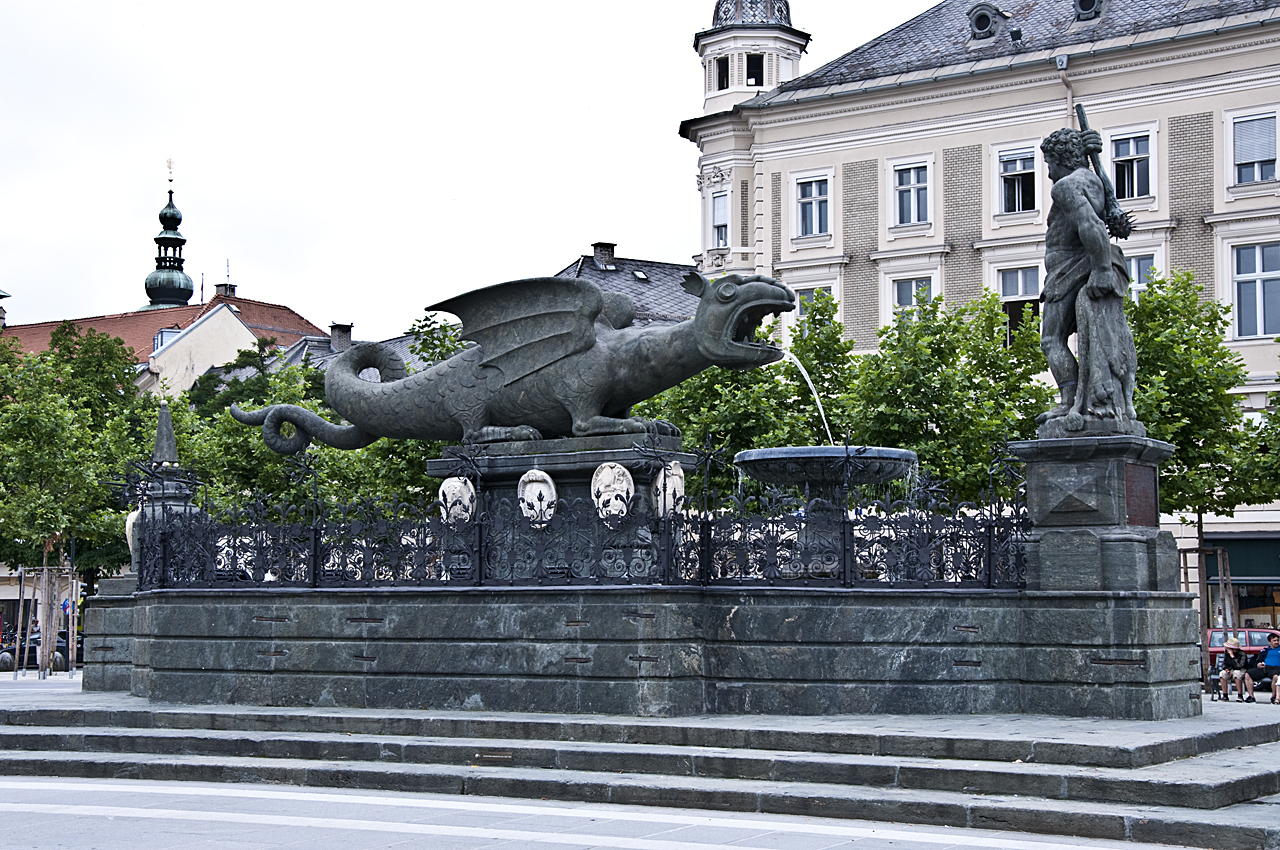
A stone lindworm with gaping jaws has been the emblem of Klagenfurt since the 16th century. Its head is said to have been modelled on the skull of an Ice Age woolly rhinoceros.
Interesting facts
- Lindworm commissioned in 1583
- Carved from a single block of chlorite schist, about six tonnes
- Hercules statue from 1636
- 1840: theory of a woolly rhinoceros skull as the model
Why visit
- The emblem of Klagenfurt
- A dragon fountain from the 16th and 17th centuries
- A piece of the history of science in the city centre
The Lindwurm Fountain (Lindwurmbrunnen) stands on Neuer Platz in Klagenfurt am Wörthersee and depicts the heraldic animal of the city. The Carinthian Estates commissioned the lindworm in 1583. It was carved from a single block of chlorite schist from the nearby Kreuzbergl; who made it is uncertain. According to legend, the area only became habitable after brave men slew a lindworm here.
The monument took decades to complete. The fountain was not added until 1624, and since then water has poured from the lindworm’s mouth. The wrought-iron railing in late Renaissance style followed in 1634, and the statue of Hercules wielding his club by Michael Hönel in 1636. In 1972 the fountain was moved a little to the west, to its present position, when an underground car park was built beneath the square.
The lindworm also has a place in the history of science. In 1840 the palaeontologist Franz Unger suggested that its head was modelled on a skull found near Klagenfurt in the 14th century, which came from a woolly rhinoceros. For this reason some regard the sculpture as the earliest reconstruction of an extinct animal, although a direct link has not been proven. The skull was given to the regional natural history museum in 1849.
History
The Carinthian Estates commissioned the lindworm in 1583. The work was long attributed to Ulrich Vogelsang but is probably by an unknown master. The fountain was added in 1624, the railing by Georg Tillitz in 1634 and the Hercules statue by Michael Hönel in 1636. Moved to the west in 1972 for an underground car park; a general restoration was completed in 1997.
Special features
The chlorite schist lindworm weighs about six tonnes and was carved from a single block. Coats of arms of Carinthian officials decorate the base, and the Carinthian coat of arms beneath an obelisk sits on the west side. Locals sometimes call the dragon “Lindi”.
Map
Opens an external route planner. Please check access and opening times before you set off.
Sources
Image: Zacke82 · CC BY-SA 3.0 · Wikimedia Commons

Last reviewed: November 4, 2026