Location: Austria Burgenland
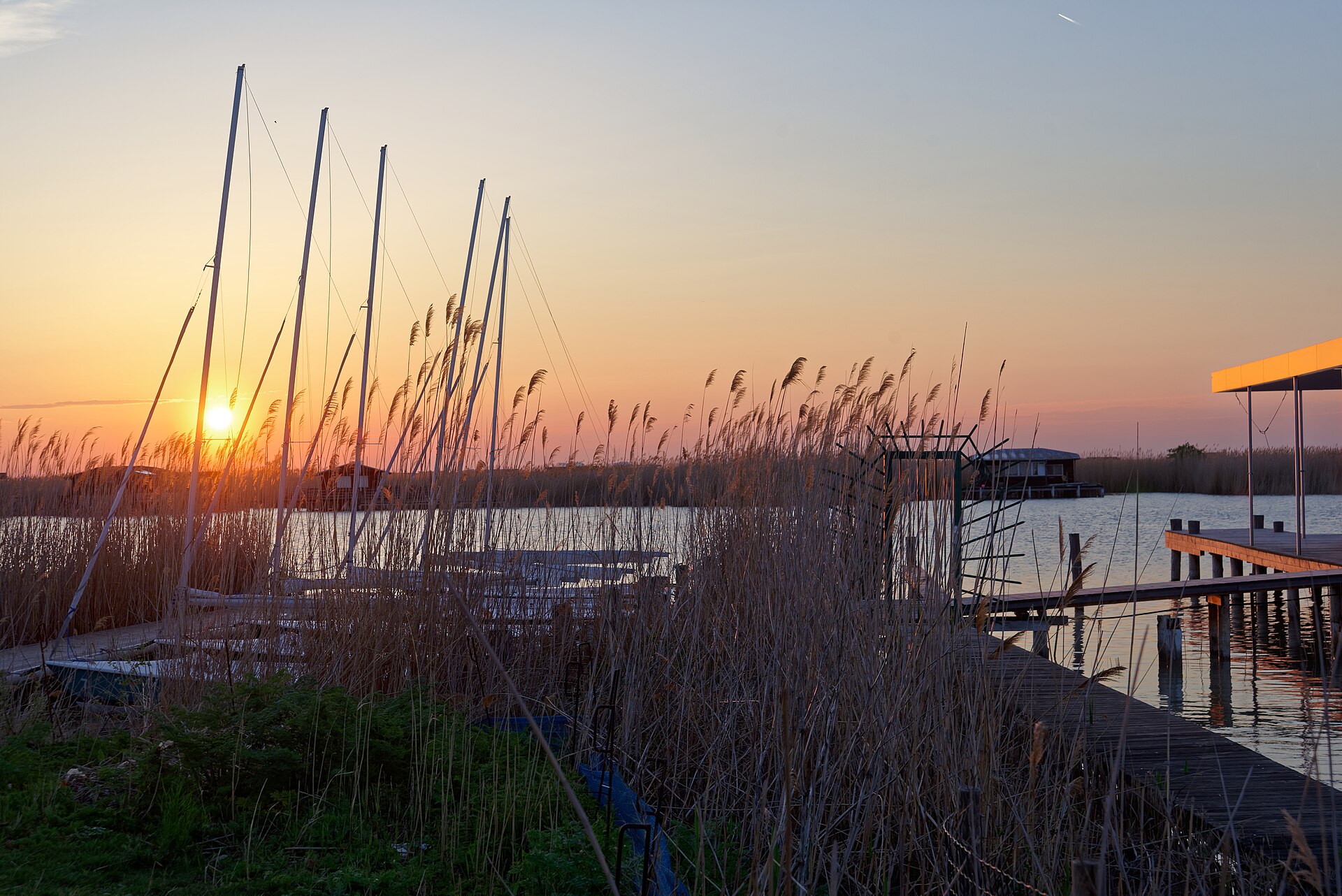
The largest lake without a natural outflow in Central Europe: a shallow steppe lake on the Austrian–Hungarian border, surrounded by one of Europe's largest reed beds.
Interesting facts
- Largest lake without an outflow in Central Europe
- Around 320 km² in area, barely 2 m deep
- Second-largest continuous reed area in Europe after the Danube Delta
- UNESCO World Heritage Site since 2001
- Cycle path around the lake: about 135 km
Why visit
- A steppe lake with vast reed landscapes
- A protected area for birds and other wildlife
- Plenty of water sports and a cycling loop around the whole lake
- An operetta stage right by the water in Mörbisch
Lake Neusiedl in northern Burgenland is one of the few steppe lakes in Europe and the largest lake in Central Europe without a natural outflow. Depending on the water level it covers around 320 square kilometres; the larger part lies in Austria, the south in Hungary, where it is called Fertő tó. Despite its size it is very shallow: even at its deepest points it is barely two metres deep.
About half of the lake’s surface is covered with reeds. After the Danube Delta, this is the largest continuous reed area in Europe and home to rich wildlife. The landscape is protected by the Neusiedler See-Seewinkel and Fertő-Hanság national parks, and since 2001 it has been a UNESCO World Heritage Site as the Fertő/Neusiedlersee Cultural Landscape. Vineyards cover the slopes around the lake.
The water level depends heavily on rainfall and varies considerably. The lake last dried up completely between 1864 and 1870, when rice was even grown on the dry lake bed. With global warming, it is once again at risk of drying out. Visitors come for sailing, surfing and swimming, for example at Podersdorf on the only stretch of shore without reeds, for the cycle path of around 135 kilometres around the lake, and in summer for the operettas of the Mörbisch Lake Festival on a stage by the water.
History
During its last complete drying-out from 1864 to 1870, rice was grown on the lake bed. Construction of the Einser Canal began in 1895. The area has been a UNESCO World Heritage Site since 2001 (Fertő/Neusiedlersee Cultural Landscape). Because of global warming, the lake is increasingly threatened by drying out.
Special features
Shallow steppe lake without a natural outflow, around 320 km² in area and barely two metres deep, about half covered with reeds. National parks on the Austrian and Hungarian sides, bathing resorts and harbours along the shore, a cycle path around the lake and a lake stage in Mörbisch.
Map
Opens an external route planner. Please check access and opening times before you set off.
Sources
- Wikipedia (de): Neusiedler See
- Wikipedia (en): Lake Neusiedl
- Wikivoyage (de): Neusiedler See
- Wikidata: Q6396
Image: Jakub Hałun · CC BY-SA 4.0 · Wikimedia Commons

Last reviewed: November 9, 2026