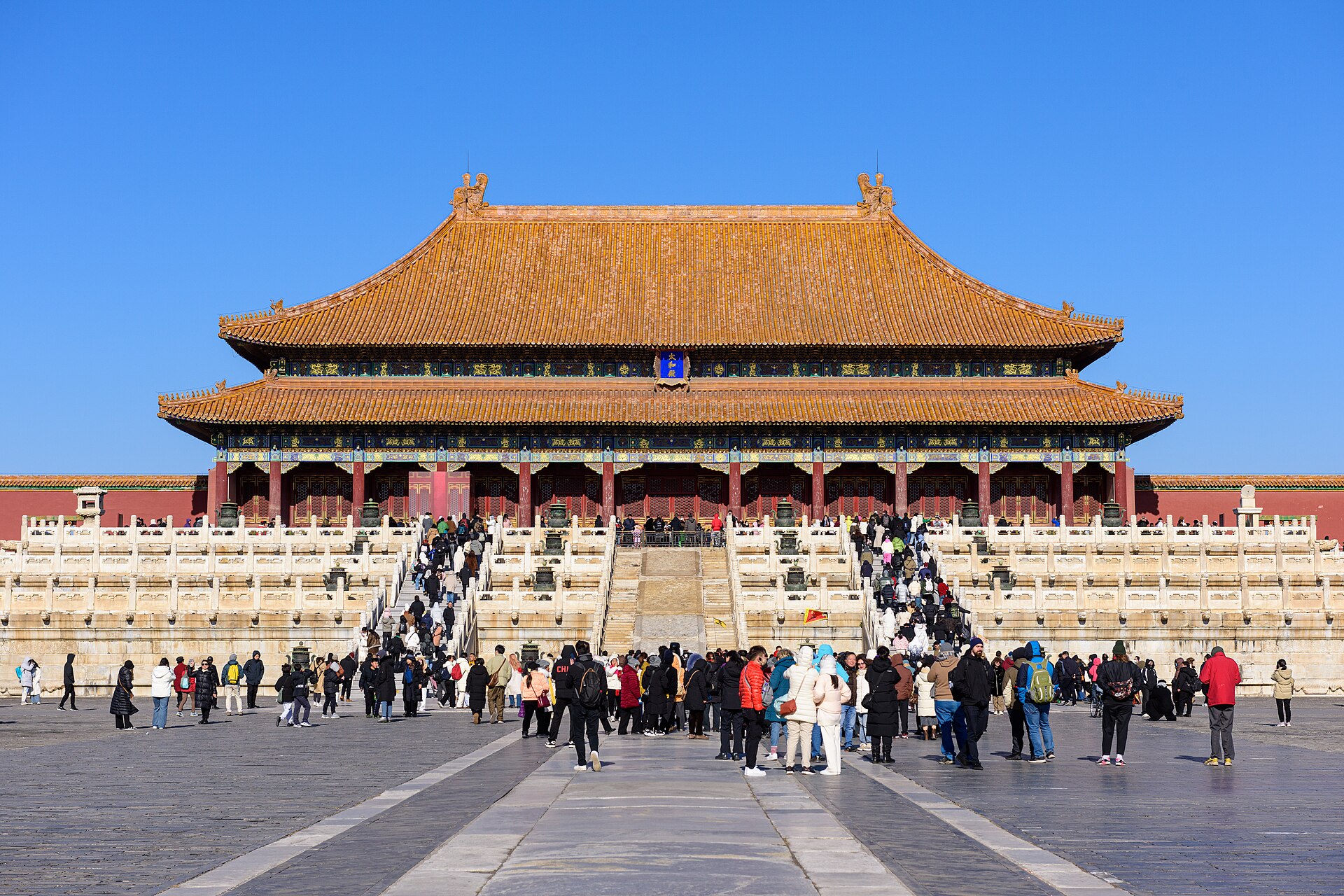
For almost five centuries, China's emperors ruled from here. The palace complex in the centre of Beijing is the largest preserved of its kind, a UNESCO World Heritage Site and now a museum.
Interesting facts
- Built from 1406 to 1420
- Residence of 24 emperors of the Ming and Qing dynasties
- Around 72 hectares and 8,886 rooms
- UNESCO World Heritage Site since 1987
- More than 19 million visitors in 2019
Why visit
- The largest preserved palace complex in the world
- Almost 500 years of Chinese imperial history in one place
- A masterpiece of Chinese architecture
The Forbidden City is the former imperial residence in the centre of Beijing, at the northern end of Tiananmen Square. Twenty-four emperors of the Ming and Qing dynasties lived here. Ordinary people were not allowed inside, hence the name. The complex has been a UNESCO World Heritage Site since 1987 and is regarded as the largest preserved palace complex in the world.
The Yongle Emperor had the palace built from 1406, and it was completed in 1420. Later rulers did not change its layout, strictly aligned on a north–south axis. The last emperor, Puyi, abdicated in 1912 but was allowed to live in the palace until 1924. Since 1925 the complex has been run by the Palace Museum, whose collection is based on the imperial holdings.
By modern counts the roughly 72 hectares hold 8,886 rooms; tradition claims 9,999. A wall ten metres high and a moat 52 metres wide surround the grounds. The southern part served state business and ceremonies, while the imperial family lived in the north. The ceremonial area includes the Hall of Supreme Harmony on white marble terraces. The yellow roof tiles bear the colour reserved for the emperor.
History
Built from 1406 to 1420 under the Yongle Emperor of the Ming dynasty. In 1644 the palace was badly damaged during the fall of the Ming; the emperors of the Qing dynasty then resided here. British and French troops occupied the complex in 1860. Puyi abdicated in 1912 and had to leave the palace in 1924. Palace Museum since 1925, UNESCO World Heritage Site since 1987.
Special features
The Hall of Supreme Harmony, 35 metres high, with the Dragon Throne was the setting for enthronements and major celebrations. The main entrance is the Meridian Gate, corner towers stand at the four corners of the wall, and the Imperial Garden lies north of the residential palaces.
Map
Opens an external route planner. Please check access and opening times before you set off.
Sources
Image: N509FZ · CC BY-SA 4.0 · Wikimedia Commons

Last reviewed: November 2, 2026